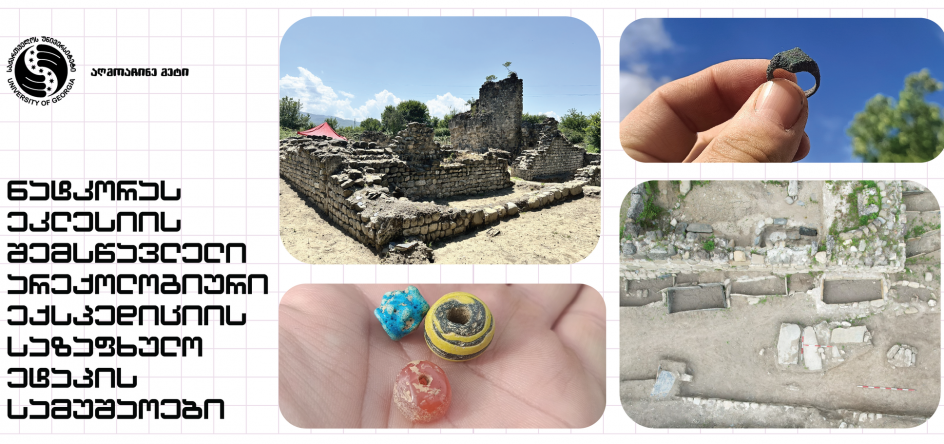
This phase focused on the archaeological and interdisciplinary study of the cemetery located to the south and east of the church.
The research project was initiated in 2023 by Professor Manana Sanadze, Director of the T. Beradze Institute of Georgian Studies. Through a critical analysis of relevant passages in Kartlis Tskhovreba (The Georgian Chronicles), Professor Sanadze identified the likely location of the burial of King Darchil, son of King Vakhtang Gorgasali of Kartli, in the central nave of the church. The subsequent discovery of the burial has been recognized as one of the most significant archaeological findings of recent years.
Excavations at the church and the adjoining cemetery are led by Professor David Berikashvili. Under his mentorship, archaeology students from the University of Georgia, at both undergraduate and master’s levels, as well as students from Telavi State University, have participated in fieldwork and laboratory research.
This year’s field season produced particularly important results in the southern part of the church complex. Excavations there revealed architectural details of the early church, along with several significant burials, including collective interments. These contexts have yielded valuable archaeological and bioarchaeological material, offering new opportunities for understanding the population and practices associated with the site.
A portion of the archaeological material has been transferred to the University of Georgia, where it is being prepared for conservation and restoration. The bioarchaeological remains are currently undergoing initial analysis and will subsequently be prepared for genetic and other interdisciplinary studies.
The research is being conducted in close coordination with the Alaverdi Eparchy. A working meeting is planned in the near future to discuss the preliminary conservation and rehabilitation proposal, as well as the future directions and prospects of the scientific research.
Natkora is one of the earliest and most significant early Christian monuments in eastern Georgia, with its construction traditionally associated with King Darchil. Once the research, conservation, and rehabilitation initiatives are completed, the site is expected to become an important addition to the group of historical and archaeological monuments being studied and preserved by the University of Georgia.